


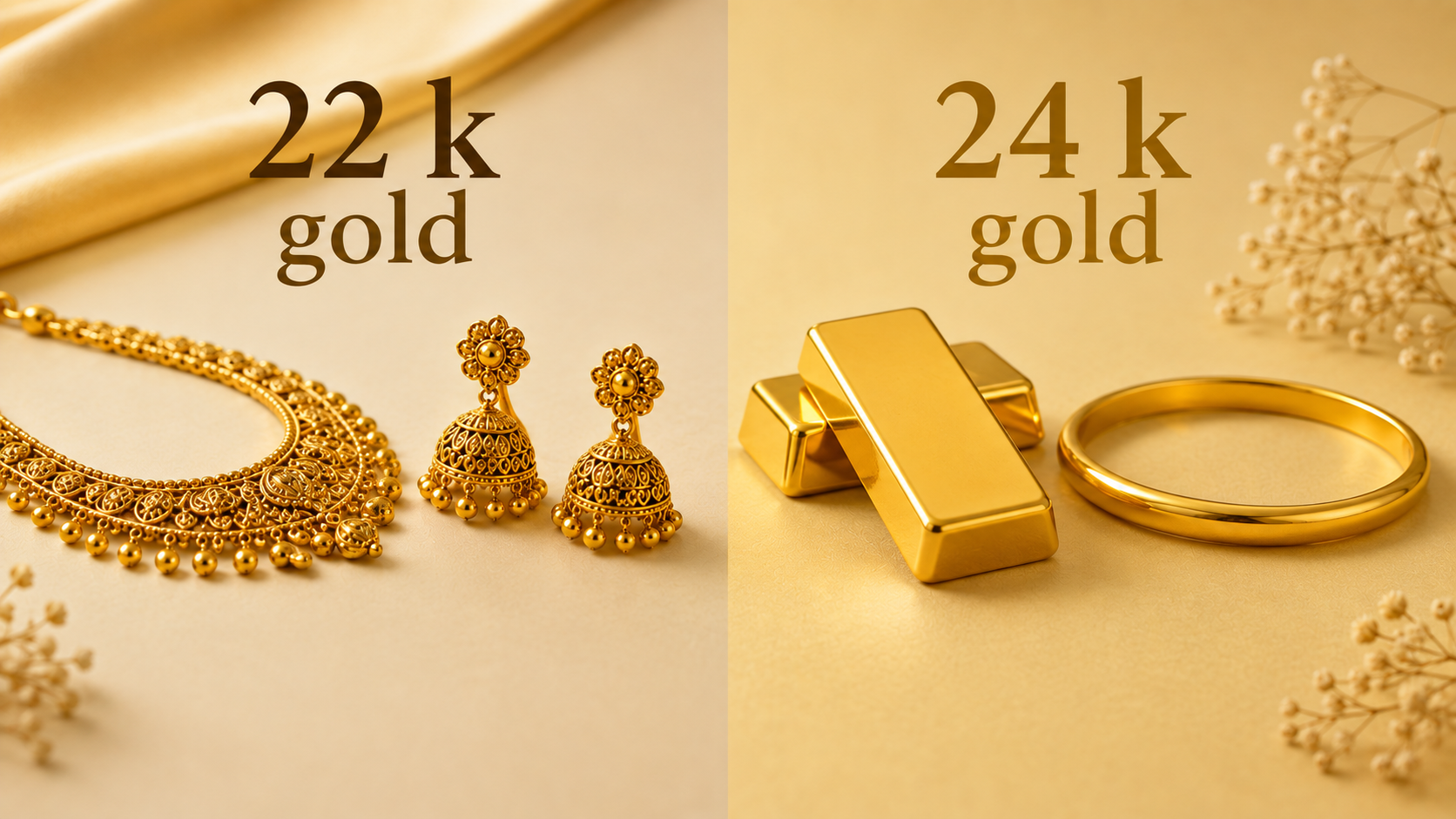
Are you confused about 22K vs 24K gold while planning to buy gold jewellery or a gold product? The two terms refer to different levels of gold purity but the difference is not limited to purity alone. Their hardness, appearance, jewellery suitability, price and common uses also differ.
For jewellery buyers, understanding these differences can help you choose gold that suits your purpose instead of simply choosing the highest purity available. 24K gold offers the highest karat purity, while 22K gold contains slightly more alloying metals, which makes it harder and generally more practical for jewellery.
What Does Karat Mean in Gold?
Karat (K) is a measure of gold purity based on a 24-part scale. The higher the karat, the greater the proportion of gold in the alloy.
Karat vs Carat: What’s the Difference?
Karat (K) and carat (ct) are different measurements:
- Karat (K): Measures the purity of gold.
- Carat (ct): Measures the weight of a gemstone, such as a diamond.
So, when discussing 22K vs 24K gold, “karat” is the correct term for referring to gold purity.
Understanding the 24-Karat Scale
The karat system shows the proportion of pure gold in 24 parts of a gold alloy:
| Gold Purity | Approx. Gold Content | Common Fineness |
| 24K | Highest karat purity | 995* |
| 22K | 91.6% | 916 |
| 18K | 75% | 750 |
| 14K | 58.5% | 585 |
For example, 22K gold contains 22 parts gold out of 24, while 18K gold contains 18 parts. As the karat decreases, the proportion of alloying metals increases.
Important Note: *Fineness markings can vary by applicable standard and product. In India, BIS lists 24KS (995), 22K (916), 18K (750) and 14K (585) among its permitted gold hallmark grades.
What Is Gold Fineness?
Gold fineness shows how much pure gold is present in 1,000 parts of an alloy. It helps buyers understand the purity of gold jewellery.
- 916 fineness means approximately 916 parts per 1,000 are pure gold.
- 22K gold is commonly represented by 916 fineness.
- BIS recognizes 22K (916) as a gold hallmark grade in India.
- Applicable hallmarked gold jewellery carries the BIS logo, purity/fineness mark and six-digit HUID.
- The HUID can be verified through the BIS Care App.
Understanding fineness makes it easier to compare 22K vs 24K gold and make informed jewellery-buying decisions.
Why Does Gold Purity Matter?
Gold purity affects more than just how much gold a piece contains. It can influence several practical and visual characteristics of the jewellery.
Factors Influenced by Gold Purity
- Hardness: Higher-purity gold is generally softer.
- Durability: Alloying metals can make gold more resistant to everyday wear.
- Colour: Gold purity and alloy composition can affect its appearance.
- Jewellery suitability: Different purities suit different jewellery designs and uses.
- Value: Gold content is an important factor in determining the value of a gold item.
Knowing these differences helps you choose a gold purity that matches your jewellery needs, wearing habits and budget.
What Is 22K Gold?
22K gold is a high-purity gold alloy containing approximately 91.6% pure gold. The remaining portion consists of other metals that add hardness and strength, making it more practical for jewellery than higher-purity gold.
Characteristics of 22K Gold
22K gold is known for:
- High gold content: Approximately 91.6% pure gold.
- Rich yellow colour: It has the warm, traditional appearance associated with high-purity gold.
- Greater hardness: It is harder than 24K gold because of its alloy content.
- Jewellery suitability: Its balance of purity and hardness makes it suitable for many jewellery designs.
- Traditional appeal: 22K gold is widely preferred for traditional and occasion-based gold jewellery.
Is 22K Gold Pure Gold?
No, 22K gold is not 100% pure gold. It contains 22 parts gold out of 24, with the remaining 2 parts made up of alloying metals. This is why 22K gold is commonly associated with 916 fineness.
22K gold offers a practical balance between high purity and the strength needed for many jewellery applications.
What Is 24K Gold?
24K gold represents the highest karat purity, containing the greatest proportion of gold. Its high purity makes it naturally softer and more prone to bending or scratching than lower-karat gold alloys.
Characteristics of 24K Gold
24K gold is generally known for:
- Highest karat purity: It has the greatest proportion of gold on the karat scale.
- Rich yellow colour: Its high gold content gives it a distinctive yellow appearance.
- Greater softness: It is softer than lower-karat gold alloys.
- Lower hardness: Compared with 22K gold, it is less resistant to bending and deformation.
- High-purity applications: It is commonly used in suitable high-purity gold products, including certain coins and bars.
Is 24K Gold Pure Gold?
24K is the highest karat designation but the actual fineness should be checked on the product. For example, BIS lists 24KS (995) among its permitted gold hallmark grades in India.
Therefore, when buying gold, check the purity or fineness marking rather than relying only on the “24K” label.
Its high purity makes 24K gold valuable but its softness is an important consideration when choosing gold for jewellery.
22K vs 24K Gold: What’s the Difference?
The main difference between 22K and 24K gold is their gold content, which also affects hardness, durability, colour and suitability for different uses.
| Feature | 22K Gold | 24K Gold |
| Gold purity | High purity, with approximately 91.6% gold | Highest karat purity |
| Fineness | 916 | 995* |
| Alloy content | Contains a higher proportion of alloying metals | Contains very little alloying material |
| Hardness | Harder than 24K because of its alloy content | Softer due to its higher gold content |
| Durability | More practical for regular jewellery use | More prone to bending and scratching |
| Colour | Rich yellow appearance | Typically a more intense yellow |
| Weight | Weight depends on the piece’s size, design and construction; it cannot determine purity | Weight depends on the piece’s size, design and construction; it cannot determine purity |
| Jewellery suitability | Generally more suitable for many jewellery designs | Less suitable for many everyday jewellery designs because of its softness |
| Common uses | Gold jewellery and ornaments | High-purity gold products such as coins and bars |
| Best suited for | Jewellery where a balance of purity and hardness is desired | Situations where maximum gold purity is the priority |
Why Is 24K Gold Softer Than 22K Gold?
24K gold is softer than 22K because it contains more gold and less alloying metal. This makes 22K gold generally more practical for jewellery due to its greater hardness and strength.
Why Does Softness Matter in Jewellery?
Softer gold can be more susceptible to:
- Scratches from regular contact
- Bending from pressure or impact
- Deformation during everyday use
22K gold can offer a practical balance of purity, hardness and durability for many jewellery applications.
One important difference in 22K vs 24K gold is hardness: 24K gold is softer because it contains more gold and less alloying metal.
Why Is 22K Gold Commonly Used for Jewellery?
In the 22K vs 24K gold comparison, 22K remains popular for jewellery due to its 91.6% gold content, rich yellow appearance and suitability for traditional designs.
It is commonly used for:
- Necklaces and chains
- Bangles and bracelets
- Earrings
- Rings
- Traditional gold ornaments
The ideal gold purity ultimately depends on the jewellery design, intended use and personal preference.
22K vs 24K Gold: Which Is Better for Different Uses?
The better choice depends on how you plan to use the gold, whether for jewellery, everyday wear, maximum purity or investment.
Use the table below to compare 22K and 24K gold based on different purposes and priorities.
| Purpose | Better-Suited Option | Why |
| Gold jewellery | 22K | High purity and suitable for many jewellery designs |
| Everyday jewellery | 22K | More practical for regular wear |
| Traditional jewellery | 22K | High gold content and rich yellow appearance |
| Maximum gold purity | 24K | Contains a higher proportion of gold |
| High-purity gold products | 24K | Suitable when high gold content is the priority |
| Gold coins | Usually 24K | High-purity coins are commonly preferred |
| Investment | Depends on the product | Purity, premiums, liquidity and resale terms all matter |
Ultimately, the right gold purity depends on your purpose, priorities and how you plan to use the gold.
22K vs 24K Gold Price: Why Is There a Difference?
Understanding 22K vs 24K gold price differences can help you compare the value of different gold products. 24K gold generally costs more per unit of weight than 22K because it contains a higher proportion of gold.
The final price of gold jewellery depends on several factors, including:
- Gold weight
- Purity
- Making charges
- Design and craftsmanship
- Applicable taxes
What Is the Price Difference Between 22K and 24K Gold?
The price difference changes with the current gold rate and market conditions. For the same weight, 24K generally has a higher gold value due to its greater gold content, while jewellery charges can affect the final price.
22K vs 24K Gold Coins: Which Is Better?
24K is generally preferred for gold coins when maximum purity is the priority. When comparing coins, consider the actual fineness, weight, premium, documentation and seller credibility rather than karat alone.
- Purity and fineness: Check the exact fineness stated for the coin.
- Weight: Verify the declared weight.
- Premium: Compare the price over the underlying gold value.
- Seller or mint: Choose a credible and authorized source.
- Documentation: Check the product details and purchase invoice.
- Resale terms: Understand the seller’s buyback or resale policy.
In India, BIS states that the mandatory hallmarking order applies to gold jewellery and artefacts, while gold bullion and coins of 999/995 fineness can be hallmarked by BIS-approved refineries or mints. (Bureau of Indian Standards)
Therefore, when buying a gold coin, check its actual fineness and documentation rather than assuming that jewellery hallmarking rules apply in the same way.
How to Differentiate Between 22K and 24K Gold
The most reliable way to check gold purity is to verify its official purity marking and hallmark details rather than relying on appearance.
1. Check the Purity Mark
Look for the karat and fineness marking on the jewellery. For example, 22K916 indicates 22K gold with 916 fineness.
2. Verify the BIS Hallmark and HUID
For applicable hallmarked gold jewellery in India, check for:
- BIS logo
- Purity/fineness mark
- Six-digit HUID
The HUID can be verified using the BIS Care App.
3. Check the Invoice
The invoice should clearly mention important details such as the article description, net precious-metal weight and purity/fineness. BIS Consumer FAQ
4. Get Professional Testing When Needed
If the purity of an existing gold item is uncertain, professional methods such as XRF testing or assaying can provide a more reliable purity assessment. You can also consider a BIS-recognized Assaying & Hallmarking Centre for testing. BIS Consumer Protection Guidance
Avoid relying on colour, weight or appearance alone to determine whether gold is 22K or 24K.
Buying Gold Jewellery from a Trusted Jeweller
When buying gold jewellery, purity is only one part of a good purchase. Buyers should also consider hallmarking, product weight, design, workmanship, pricing and after-sales policies.
BIS recommends that consumers obtain an authentic bill/invoice for hallmarked articles and says details of the hallmarked article should be included in the invoice.
A reliable jeweller should make these details easy to understand before you complete your purchase.
Gold Jewellery at Santushti Jewellers
For buyers exploring gold jewellery in Chandigarh, Santushti Jewellers offers jewellery across gold and other precious-metal categories. You can explore the available collection and compare designs according to your preferred purity, style and occasion.
Contact Details
Santushti (By B.S.A. Jewels)
Address: SCO-41, First Floor, Sector-19D, Chandigarh – 160019, India
Phone: +91 8699911941
Email: sales@santushti.co
Final Thoughts on 22K vs 24K Gold
The choice between 22K vs 24K gold depends on your priorities. 24K offers the highest karat purity, while 22K provides high gold content with greater hardness, making it generally more practical for many jewellery applications and traditional designs.
Before buying, check the purity, fineness, applicable BIS hallmark, HUID, weight and total price rather than relying on colour alone. For quality-focused gold jewellery in Chandigarh, explore trusted collections from Santushti Jewellers and choose according to your needs.
FAQs – 22K vs 24K Gold: Difference, Purity & Which Is Better?
Q1. What is the difference between 22K and 24K gold?
Ans. 24K gold has a higher proportion of gold than 22K gold. 22K contains approximately 91.6% gold, while 24K represents the highest karat purity. The difference also affects hardness and jewellery suitability.
Q2. Which is better, 22K or 24K gold?
Ans. It depends on the purpose. 22K gold is generally more suitable for many jewellery applications, while 24K is preferred when maximum gold purity is the main priority.
Q3. Can I wear 22K gold every day?
Ans. Yes, 22K gold can be worn regularly, although its high gold content makes it softer than lower-karat gold. Proper care can help reduce scratches, bending and other signs of wear.
Q4. What is the disadvantage of 24K gold?
Ans. The main disadvantage of 24K gold for jewellery is its softness. It is more susceptible to scratches, bending and deformation than gold alloys containing more strengthening metals.
Q5. Which is better for investment, 22K or 24K gold?
Ans. The better option depends on the investment product and your objective. Consider purity, premiums, liquidity, resale terms and seller credibility rather than karat alone.